What Is Measured With Respect to Sea Level?
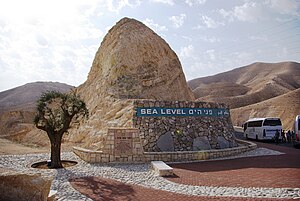
Mean sea level (MSL) (ofttimes shortened to sea level) is an boilerplate surface level of 1 or more among Earth's coastal bodies of water from which heights such every bit peak may be measured. The global MSL is a type of vertical datum – a standardised geodetic datum – that is used, for example, every bit a chart datum in cartography and marine navigation, or, in aviation, as the standard ocean level at which atmospheric pressure is measured to calibrate distance and, consequently, aircraft flight levels. A common and relatively straightforward mean sea-level standard is instead the midpoint between a mean depression and mean loftier tide at a particular location.[ane]
Sea levels tin be affected by many factors and are known to have varied profoundly over geological fourth dimension scales. However, 20th century and current millennium body of water level ascension is presumed to be caused by climate change,[2] and careful measurement of variations in MSL tin offer insights into ongoing climate alter.[three]
The term above sea level more often than not refers to above mean body of water level (AMSL). The term APSL means Above Present Sea Level, comparing sea levels in the by with the level today.
Earth's radius at sea level is 6378.137 km (3963.191 mi) at the equator. It is six,356.752 km (3,949.903 mi) at the poles and 6,371.001 km (3,958.756 mi) on average.[4]
Measurement [edit]

Sea level measurements from 23 long tide approximate records in geologically stable environments show a rise of around 200 millimetres (7.9 in) during the 20th century (two mm/yr).
Precise determination of a "mean body of water level" is hard because of the many factors that touch on ocean level.[5] Instantaneous body of water level varies quite a lot on several scales of fourth dimension and space. This is because the sea is in constant motion, affected past the tides, current of air, atmospheric force per unit area, local gravitational differences, temperature, salinity and and then along. The easiest way this may exist calculated is by selecting a location and calculating the mean sea level at that point and use it as a datum. For instance, a period of 19 years of hourly level observations may exist averaged and used to determine the mean sea level at some measurement point.
Still-h2o level or even so-water ocean level (SWL) is the level of the bounding main with motions such every bit wind waves averaged out.[half dozen] Then MSL implies the SWL further averaged over a period of fourth dimension such that changes due to, e.g., the tides, as well have zero mean. Global MSL refers to a spatial boilerplate over the unabridged bounding main.
Ane often measures the values of MSL in respect to the land; hence a change in relative MSL tin effect from a real change in bounding main level, or from a change in the top of the country on which the tide gauge operates. In the Great britain, the Ordnance Datum (the 0 metres height on UK maps) is the mean sea level measured at Newlyn in Cornwall between 1915 and 1921.[7] Earlier 1921, the vertical datum was MSL at the Victoria Dock, Liverpool. Since the times of the Russian Empire, in Russia and its other quondam parts, now contained states, the sea level is measured from the zilch level of Kronstadt Sea-Gauge. In Hong Kong, "mPD" is a surveying term pregnant "metres above Principal Datum" and refers to height of 1.230m below the average sea level. In France, the Marégraphe in Marseilles measures continuously the sea level since 1883 and offers the longest collated information about the sea level. It is used for a function of continental Europe and the main part of Africa every bit the official sea level. Kingdom of spain uses the reference to measure heights beneath or higher up bounding main level at Alicante, and some other European vertical elevation reference (European Vertical Reference System) is to the Amsterdam Peil peak, which dates back to the 1690s.
Satellite altimeters accept been making precise measurements of sea level[8] since the launch of TOPEX/Poseidon in 1992. A joint mission of NASA and CNES, TOPEX/Poseidon was followed by Jason-1 in 2001 and the Ocean Surface Topography Mission on the Jason-2 satellite in 2008.
Height higher up hateful sea level [edit]
Top above mean sea level (AMSL) is the elevation (on the basis) or altitude (in the air) of an object, relative to the average ocean level datum. Information technology is also used in aviation, where some heights are recorded and reported with respect to mean sea level (MSL) (contrast with flight level), and in the atmospheric sciences, and land surveying. An culling is to base of operations height measurements on an ellipsoid of the entire World, which is what systems such equally GPS practice. In aviation, the ellipsoid known every bit World Geodetic Organization 84 is increasingly used to define heights; yet, differences up to 100 metres (328 anxiety) [ citation needed ] exist between this ellipsoid height and mean tidal height. The alternative is to use a geoid-based vertical datum such as NAVD88 and the global EGM96 (part of WGS84).
When referring to geographic features such as mountains on a topographic map, variations in elevation are shown past profile lines. The elevation of a mount denotes the highest point or top and is typically illustrated every bit a small circumvolve on a topographic map with the AMSL height shown in metres, feet or both.
In the rare case that a location is beneath sea level, the elevation AMSL is negative. For one such case, see Amsterdam Aerodrome Schiphol.
Difficulties in use [edit]

- Body of water
- Reference ellipsoid
- Local plumb line
- Continent
- Geoid
To extend this definition far from the body of water means comparing the local height of the mean bounding main surface with a "level" reference surface, or geodetic datum, called the geoid. In a state of remainder or absence of external forces, the mean bounding main level would coincide with this geoid surface, being an equipotential surface of the Earth'due south gravitational field which, in itself, does not conform to a unproblematic sphere or ellipsoid and exhibits measurable variations such every bit those measured by NASA's GRACE satellites to decide mass changes in ice-sheets and aquifers. In reality, this ideal does not occur due to ocean currents, air pressure variations, temperature and salinity variations, etc., not fifty-fifty as a long-term average. The location-dependent, but persistent in fourth dimension, separation betwixt hateful sea level and the geoid is referred to equally (mean) body of water surface topography. It varies globally in a range of ±21000.
Dry out land [edit]

Several terms are used to describe the changing relationships between ocean level and dry land.
- "relative" means change relative to a stock-still indicate in the sediment pile.[9]
- "eustatic" refers to global changes in sea level relative to a fixed point, such as the heart of the earth, for instance every bit a result of melting ice-caps.[10]
- "steric" refers to global changes in sea level due to thermal expansion and salinity variations.[eleven]
- "isostatic" refers to changes in the level of the land relative to a fixed point in the earth, possibly due to thermal buoyancy or tectonic furnishings; information technology implies no change in the volume of h2o in the oceans.[ dubious ]
The melting of glaciers at the end of ice ages is 1 example of eustatic body of water level rise. The subsidence of land due to the withdrawal of groundwater is an isostatic crusade of relative sea level rise.
Paleoclimatologists can track sea level by examining the rocks deposited along coasts that are very tectonically stable, like the east coast of North America. Areas like volcanic islands are experiencing relative sea level rise every bit a consequence of isostatic cooling of the rock which causes the land to sink.
On other planets that lack a liquid bounding main, planetologists can calculate a "mean distance" by averaging the heights of all points on the surface. This altitude, sometimes referred to every bit a "sea level" or nix-level elevation, serves equivalently equally a reference for the height of planetary features.
Modify [edit]
Local and eustatic [edit]
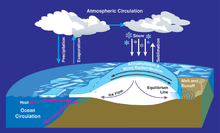
Local hateful bounding main level (LMSL) is defined as the pinnacle of the ocean with respect to a land benchmark, averaged over a menstruum of time (such as a month or a twelvemonth) long enough that fluctuations caused past waves and tides are smoothed out. One must adapt perceived changes in LMSL to account for vertical movements of the land, which can be of the aforementioned order (mm/twelvemonth) every bit sea level changes. Some land movements occur because of isostatic adjustment of the curtain to the melting of ice sheets at the end of the last ice historic period. The weight of the ice sheet depresses the underlying land, and when the ice melts away the land slowly rebounds. Changes in ground-based ice volume also bear upon local and regional bounding main levels by the readjustment of the geoid and true polar wander. Atmospheric pressure, ocean currents and local sea temperature changes can touch LMSL as well.
Eustatic bounding main level modify (as opposed to local change) results in an amending to the global sea levels due to changes in either the volume of water in the world'southward oceans or net changes in the volume of the oceanic basins.[12]
Short-term and periodic changes [edit]

Melting glaciers are causing a change in sea level
There are many factors which can produce short-term (a few minutes to 14 months) changes in sea level. Two major mechanisms are causing sea level to rise. Kickoff, shrinking country ice, such equally mount glaciers and polar water ice sheets, is releasing h2o into the oceans. Second, equally ocean temperatures rise, the warmer h2o expands.[thirteen]
| Periodic sea level changes | ||
|---|---|---|
| Diurnal and semidiurnal astronomical tides | 12–24 h P | 0.2–ten+ m |
| Long-period tides | ||
| Rotational variations (Chandler wobble) | 14-month P | |
| Meteorological and oceanographic fluctuations | ||
| Atmospheric pressure | Hours to months | −0.7 to 1.3 yard |
| Winds (storm surges) | i–v days | Upward to 5 yard |
| Evaporation and atmospheric precipitation (may also follow long-term blueprint) | Days to weeks | |
| Bounding main surface topography (changes in water density and currents) | Days to weeks | Up to 1 m |
| El Niño/southern oscillation | 6 mo every 5–x yr | Up to 0.6 m |
| Seasonal variations | ||
| Seasonal water balance amid oceans (Atlantic, Pacific, Indian) | ||
| Seasonal variations in gradient of water surface | ||
| River runoff/floods | 2 months | 1 thou |
| Seasonal water density changes (temperature and salinity) | vi months | 0.2 m |
| Seiches | ||
| Seiches (standing waves) | Minutes to hours | Up to 2 m |
| Earthquakes | ||
| Tsunamis (generate catastrophic long-menstruum waves) | Hours | Upwardly to 10 m |
| Abrupt alter in country level | Minutes | Up to 10 m |
Contempo changes [edit]
For at least the last 100 years, ocean level has been ascent at an average rate of about 1.eight mm (0.07 in) per yr.[fourteen] Most of this rise can be attributed to the increment in temperature of the sea and the resulting slight thermal expansion of the upper 500 metres (1,640 anxiety) of sea h2o. Additional contributions, as much as one-quarter of the total, come from water sources on country, such as melting snow and glaciers and extraction of groundwater for irrigation and other agricultural and man uses.[15]
Aviation [edit]
Pilots can estimate elevation above body of water level with an altimeter fix to a defined barometric force per unit area. By and large, the pressure used to set the altimeter is the barometric pressure that would exist at MSL in the region being flown over. This force per unit area is referred to as either QNH or "altimeter" and is transmitted to the pilot by radio from air traffic control (ATC) or an automatic concluding information service (ATIS). Since the terrain summit is also referenced to MSL, the pilot can guess meridian above ground past subtracting the terrain distance from the altimeter reading. Aviation charts are divided into boxes and the maximum terrain altitude from MSL in each box is clearly indicated. Once above the transition altitude, the altimeter is prepare to the international standard temper (ISA) pressure at MSL which is 1013.25 hPa or 29.92 inHg.[16]
Encounter besides [edit]
- Above ground level
- Before Present – Time scale used mainly in archaeology, geology and other scientific disciplines
- Chart datum – Level of h2o from which depths displayed on a nautical chart are measured
- Farthermost points of Earth
- Geopotential height
- Tiptop to a higher place average terrain – Elevation based on large expanse surrounding object; ofttimes used in U.S. for antenna towers
- List of places on land with elevations below sea level
- Raised embankment, also known as Marine terrace – Emergent littoral landform – Beach or wave-cutting platform raised above the shoreline past a relative fall in the sea level
- Meltwater pulse 1A – Menstruum of rapid post-glacial ocean level rise
- Metres above the Adriatic
- Amsterdam Ordnance Datum, also known equally Normaal Amsterdams Peil – Vertical datum
- Normal height
- Normalhöhennull
- Normalnull – Outdated official vertical datum used in Deutschland
- North Westward Shelf Operational Oceanographic System – Facility that monitors physical, sedimentological and ecological variables for the North Body of water area
- Ordnance datum – Vertical datum used every bit the basis for deriving altitudes on maps (U.k. and Ireland)
- Orthometric height – Distance above geoid or mean sea level
- Bounding main level equation
- Vertical datum – Reference surface for vertical positions
- World Geodetic System – Geodetic reference organization
References [edit]
- ^ What is "Mean Bounding main Level"? (Proudman Oceanographic Laboratory).
- ^ USGCRP (2017). "Climate Science Special Study. Chapter 12: Sea Level Ascension. Cardinal finding 2". science2017.globalchange.gov: i–470. Retrieved 27 December 2018.
- ^ "The strange science of melting water ice sheets: three things y'all didn't know". The Guardian. 12 September 2018.
- ^ "World Radius past Latitude Reckoner".
- ^ Usa National Research Council, Bulletin of the National Inquiry Council 1932 page 270
- ^ "Withal-h2o level - AMS Glossary". glossary.ametsoc.org.
- ^ "Ordnance Survey Benchmark locator". Retrieved 21 December 2021.
- ^ Glazman, Roman Due east; Greysukh, Alexander; Zlotnicki, Victor (1994). "Evaluating models of ocean state bias in satellite altimetry". Journal of Geophysical Enquiry. 99 (C6): 12581. Bibcode:1994JGR....9912581G. doi:10.1029/94JC00478. Roman Glazman Greysukh, A. M., Zlotnicki, V.
- ^ Jackson, Julia A., ed. (1987). "Relative rise in sea level". Glossary of geology (Fourth ed.). Alexandria, Virginia. ISBN0922152349.
- ^ Jackson, Julia A., ed. (1987). "Eustatic". Glossary of geology (Fourth ed.). Alexandria, Virginia. ISBN0922152349.
- ^ Jackson, Julia A., ed. (1987). "Steric". Glossary of geology (Fourth ed.). Alexandria, Virginia. ISBN0922152349.
- ^ "Eustatic bounding main level". Oilfield Glossary. Schlumberger Express. Retrieved 10 June 2011.
- ^ "Global Warming Effects on Sea Level". www.climatehotmap.org . Retrieved two December 2016.
- ^ Bruce C. Douglas (1997). "Global Sea Ascent: A Redetermination". Surveys in Geophysics. 18 (ii/3): 279–292. Bibcode:1997SGeo...eighteen..279D. doi:x.1023/A:1006544227856. S2CID 128387917.
- ^ Bindoff, Northward.L.; Willebrand, J.; Artale, Five.; Cazenave, A.; Gregory, J.; Gulev, Due south.; Hanawa, K.; Le Quéré, C.; Levitus, S.; Nojiri, Y.; Shum, C.K.; Talley, L.D.; Unnikrishnan, A. (2007). "Observations: Oceanic Climate Change and Sea Level" (PDF). In Solomon, S.; Qin, D.; Manning, M.; Chen, Z.; Marquis, Grand.; Averyt, K.B.; Tignor, M.; Miller, H.L. (eds.). Climate change 2007: The Concrete Science Basis. Contribution of Working Grouping I to the Fourth Cess Report of the Intergovernmental Panel on Climatic change. Cambridge University Printing.
- ^ Usa Federal Aviation Administration, Code of Federal Regulations Sec. 91.121
External links [edit]
 | Wikimedia Commons has media related to Ocean level. |
- Sea Level Ascension:Understanding the past – Improving projections for the future
- Permanent Service for Hateful Sea Level
- Global sea level alter: Conclusion and interpretation
- Surround Protection Bureau Sea level rise reports
- Properties of isostasy and eustasy
- Measuring Ocean Level from Space
- Rise Tide Video: Scripps Establishment of Oceanography
- Sea Levels Online: National Ocean Service (CO-OPS)
- Système d'Ascertainment du Niveau des Eaux Littorales (SONEL)
- Body of water level rising – How much and how fast will sea level rise over the coming centuries?
francoistivis1986.blogspot.com
Source: https://en.wikipedia.org/wiki/Sea_level
0 Response to "What Is Measured With Respect to Sea Level?"
Post a Comment